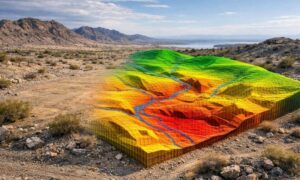
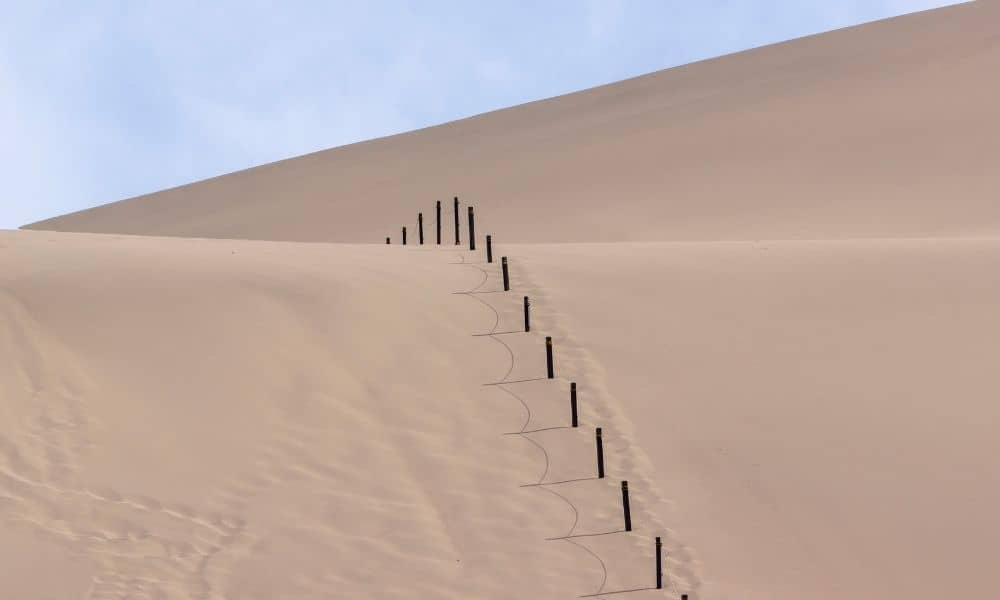
Open desert land can feel simple. The space looks wide. The edges look straight. Because of that, many property owners feel confident placing a fence or cutting in a driveway without much concern. However, desert lots hide more boundary problems than most people expect. That’s where a property line survey makes a real difference.
If you rely only on assessor maps or online parcel tools, you may build with confidence—until a problem appears. By then, the fix often costs more than doing it right the first time.
Why desert land creates false confidence
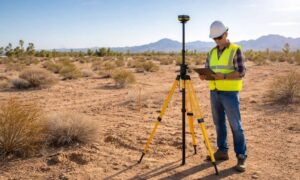
Desert properties often lack visual clues. There are no sidewalks, curbs, or long-standing fences to guide the eye. As a result, boundaries feel obvious even when they are not. Straight terrain tricks people into assuming lines run straight from road to road. In reality, many desert parcels follow angles, offsets, or old measurements that don’t match what you see on the ground.
Also, desert land changes. Wind erosion, grading, and past clearing work can move or erase old markers. Over time, the ground looks clean and open, yet the legal lines stay exactly where they were recorded. Because of this gap, guessing becomes risky.
Why assessor maps look right but lead people wrong
Assessor maps are easy to find. They load fast. They show parcel outlines with neat lines and clear shapes. Still, they were never designed for construction decisions.
These maps exist for tax assessment and recordkeeping. They show approximate parcel locations, not exact boundary positions. The lines often stretch or shift to fit a screen. When you zoom in, the map feels precise. Unfortunately, that precision is visual, not legal.
Because of that, placing a fence post based on an assessor map can put it several feet off. On a large desert lot, that mistake might go unnoticed at first. Later, when a neighbor builds or sells, the error suddenly matters.
The most common fence mistakes on desert lots
Fence problems happen for simple reasons. Many owners start from a corner they assume is correct. Others line up with a road edge or a nearby wall. Some measure from a neighbor’s fence and expect it to be accurate.
These choices feel logical. However, they ignore one key fact: none of those references confirm ownership. Roads shift. Neighbors guess too. Old fences often sit where it was convenient, not where it was legal.
Once posts go in, fixing the mistake becomes hard. Removing a fence costs time and money. Worse, it can damage relationships with neighbors who believe you crossed their land.
Driveways create even bigger risks
Driveways feel harmless, yet they cause serious boundary trouble. Concrete and asphalt are permanent. If a driveway crosses a property line or enters an easement, removing it becomes expensive fast.
Many owners place driveways based on access alone. They focus on the shortest route to the road. Still, property lines don’t always match the most direct path. In desert areas, access strips, utility corridors, or old right-of-way lines can cut across what looks like open ground.
A property line survey shows these limits before concrete is poured. That early knowledge prevents painful corrections later.
Why old markers can’t be trusted
Some property owners find metal stakes or rebar and assume they found the corner. In desert terrain, that assumption often fails.
Markers move. Grading pushes them aside. Others were never set by a licensed professional. Sometimes, surveyors placed temporary markers decades ago that no longer reflect the legal boundary.
Without documentation and verification, a marker proves nothing. A property line survey confirms whether a found marker matches the recorded boundary. That confirmation protects you from building on false information.
What a property line survey actually does
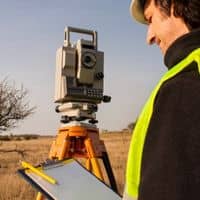
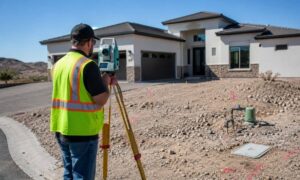
A property line survey does more than draw lines on paper. It ties your land to recorded deeds and plats. It locates legal boundaries using measured data, not visual estimates.
During the process, the surveyor checks records, measures the land, and confirms or resets corners. If encroachments exist, the survey reveals them early. That way, you can address issues before construction begins.
Most importantly, the survey gives you documentation you can rely on. It replaces assumptions with facts.
When a property line survey makes sense for homeowners
Many owners wait until a problem appears. That approach often backfires. Instead, a property line survey makes sense before you start any permanent work.
For example, order one before installing a fence, building a driveway, or clearing land near the edge of a parcel. Also, consider it when boundaries feel unclear or when no recent survey exists.
Even if no dispute exists today, the survey protects your future plans. It gives peace of mind and supports confident decisions.
The real cost of fixing mistakes later
Fixing boundary mistakes always costs more than preventing them. Fence removal, driveway demolition, and legal discussions add up fast. On top of that, stress builds when neighbors disagree.
In contrast, a survey upfront costs far less. It avoids wasted materials and delays. It also keeps projects moving without surprises.
Because of that, many owners who skip the survey regret it later. Those who order it early rarely do.
Final thoughts:
Desert land may look simple, yet property boundaries rarely are. Assessor maps help with orientation, but they don’t protect your investment. Visual clues can mislead, especially on open terrain.
A property line survey replaces guesswork with certainty. It shows where your land truly begins and ends. Before you set posts or pour concrete, knowing the facts saves money, time, and stress.
In the end, confidence comes from clarity. And clarity starts with a proper survey.